Your #1 FULL TIME WEST COAST OF FLORIDA SALTWATER CHARTER FLATS FISHING CONNECTION!!! |
 |
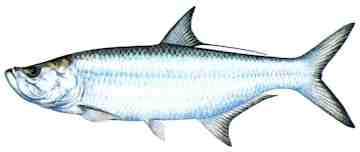
TARPON
(Megalops Atlauticus)
Description: Known as the SILVER KING, Color dark blue to green or greenish black, shading into bright silver on the sides. The dorsal fin has a long filament protruding back to the tail. This fish has a huge mouth curved upwards.
Similar Fish: (as juveniles) ladyfish.
Where Found: Primarily an inshore fish, can commonly be found on the flats and backwaters in certain times of the year depending on the location. Adult fish spawn offshore where the ribbon-like larval stage of the fish can be found.
Size: The average size in this area tends to be between 50 lbs. and 100 lbs. But 100+ lbs. Is not uncommon for the migrating fish.
Florida Record: 243 lbs.
Remarks: Tarpon are slow growers, they mature at 7 to 13 years of age. Their spawning occurs offshore between May and September, during this period females may lay more than 12 million eggs. Tarpon can tolerate a wide range of salinity’s that is why many juvenile tarpon can be found in the backwaters where fresh water and saltwater meet (brackish water).
Tackle And Techniques: Whether it’s spinning or fly-tackle, the usual tools for Tarpon tend to be attached to 20-30 pound line and an 80 lb. bite tippet. The bite tippet is mandatory even though Tarpon don’t have a lot of “bite” so to speak. The constant pressure on their sandpaper like mouth will part even 30 lb. mono in far less than the usual 45-60 minutes that it takes to battle them. If you prefer the challenge of fly-fishing, the same type of tippet is required at the end of your 12 wt fly tackle. ,
Baiting techniques: Live mullet or crabs are the top choice for live baiters. Tarpon will also take other live baits such as large shrimp, ladyfish, and pinfish. Spinning and casting anglers can use lures that resemble mullet and other baitfish. Some of the more popular lures used by Tarpon anglers are the Zara Spook, 52m MirrOlure, and the Top Dog jr. For the Fly-fisherman streamers are considered one of the best tarpon flies. Orange and red are popular colors. The cockroach is another very popular fly.
|
|---|